


On August 17, Google changes how bidding works for a large class of campaigns. If a campaign is limited by budget and runs a Target CPA or Target ROAS strategy, it will stop quietly beating its target and start delivering the target you typed in. A campaign told to hit a £50 CPA that has been delivering £35 will drift toward £50. A campaign told to hit 300% ROAS that has been returning 400% will settle toward 300%. No opt-out, no toggle. Google will not touch your targets or budgets; it will simply start believing them.
PPC LinkedIn has spent six weeks arguing about whether this is a consistency fix or a money grab. I think that is the wrong argument. Whether Google's motives are pure is unknowable and, more importantly, irrelevant. The structural fact is this: the same company sets the price, runs the auction, measures the conversion, attributes the conversion to itself, and will now enforce your efficiency target against its own scorecard. You do not need to guess at motive when the incentives are the architecture.

Both sides are right, which is the problem
Google's defence is genuinely sound. Ginny Marvin's line is that unconstrained campaigns already behave this way, and the change just makes budget-limited campaigns consistent with them: "we're making the controls clearer; the target will more precisely control your ROI" - or, as she put it in this week's follow-up Q&A, "in budget constrained campaigns, the target will now be your efficiency lever." Wijnand Meijer put the sharper version of the same point: a hard budget cap plus an efficiency target was always two contradictory orders. The cap was acting as an accidental efficiency brake, and advertisers mistook that accident for control. He is right. If your target was £50 and you were getting £35, you were never controlling efficiency. The budget was.
The critics are also right. Plenty of good operators run deliberately loose targets to give Smart Bidding room to explore beyond its safest conversions. That was a working strategy, and August 17 deletes the lever. And Greg Finn's arithmetic is hard to argue with: stated CPAs cannot rise across thousands of accounts without something in the auction rising with them. When the campaigns holding spare efficiency all start bidding to their full stated targets at once, that headroom does not vanish. It clears at auction, as price.
But notice what both camps take for granted: that the number in the target box means something. That is the assumption I want to attack, because we measure this for a living, and mostly it does not.
What the target is actually denominated in
A Target ROAS is a fraction. Revenue over spend. Google controls the denominator through the auction, and here is the part the debate keeps skipping: it also reports the numerator.
We are not guessing at this from the outside. Ringside measures conversions server-side, reconciles them order by order against the client's own backend, and (when the client wants to) pushes those conversions back into Google Ads. So for the same account, the same campaigns and the same period, we can put several defensible answers to "what did Google Ads actually drive?" side by side:
- Count only the orders where a Google ad was the strict last click: the lowest defensible answer.
- Let a machine-learned attribution model split the credit fractionally across every touch in the journey: a little higher, still below what the platform reports.
- Google's reported figure is its own credited count: orders its attribution system has decided belong to its ads, under rules it writes and applies itself. It sits above both independent lenses.
- Count every order where a Google ad appears anywhere in the journey, the most generous reading possible, and the number sits significantly above all of them.

None of these lenses is broken. Each follows its own rules and each is internally consistent. The reported number is not an outlier; it is one defensible answer among several. But it is the answer scored by the same system being scored, and from August 17 it is the only one the bidding system will enforce your target against.
One more thing about the column the target is enforced against: it is not one thing. In the account described below, a conversion action worth a few dollars per conversion sits in the headline conversions column alongside full-value orders, thousands of times over. When the system optimises "conversions" toward a target, that is the mixture it is optimising.
Google's own advice for the deadline is to set your target "based on recent performance." Recent performance under which definition? Across the defensible range the right target differs materially depending on which lens you trust. Choose the wrong end and you have either handed the algorithm a target it will burn money chasing, or one that quietly strangles a channel that was working.
The Data Manager API problem: your credit must be a whole number
There is a deeper limitation here, and it deserves its own heading because almost nobody talks about it.
Attribution, done properly, is fractional. An order with three meaningful touches should not hand one touch a 1 and the others a 0; it should split the credit. Ringside computes credit that way, and we push conversion data into Google Ads so the bidding system can learn from independently measured outcomes rather than its own homework.
Except Google's current Data Manager API will not accept fractional credit. Every conversion you push in must be a whole number. The old API allowed non-integer credited conversions, which is how attribution should work; the current one does not. So an advertiser holding a correct, fractional view of what each click actually contributed is forced to round it to integers before the machine will listen.
Sit with that alongside August 17. The bidding system is about to enforce your target with precision, in a currency where the platform's own count is one point on a wide range of defensible answers, and the API that would let you feed it something better has been narrowed so it cannot receive the precise answer. The enforcement got stricter while the input got coarser.
You can predict where this will hurt, campaign by campaign
The exact size of the shift depends on each campaign's stated target, and targets are the one thing the reporting does not expose. But the shape of the impact is predictable from data every account already has, because the mechanism is not mysterious: the budget cap has been rationing which auctions a campaign enters, and the drift on August 17 is the price of ending that rationing. The harder the cap has been rationing, the further there is to fall.
Google publishes the rationing directly: impression share lost to budget. In another client's account, the most constrained campaign enters roughly one auction in ten it is eligible for, and loses 85% of its available impression share to budget alone. Its delivery today is the cherry-picked best tenth of its market. When the stated target becomes the instruction, the system is licensed to bid into the other nine tenths, and the average has only one direction to travel. Several of that account's shopping campaigns sit in the same position, losing half or more of their impression share to budget while delivering claimed returns of four to five times spend. Across the account as a whole, well over 80% of Google spend sits in campaigns losing at least some impression share to budget.
This is not our speculation about how the system will behave. In her Q&A on the update this week, Google's Ads Liaison described the no-action case in as many words: "the system will aim to find conversions or conversion value at the average target set in the campaign. That may mean entering different auctions than you previously competed in." Entering different auctions than you previously competed in is the mechanism, from the platform itself.
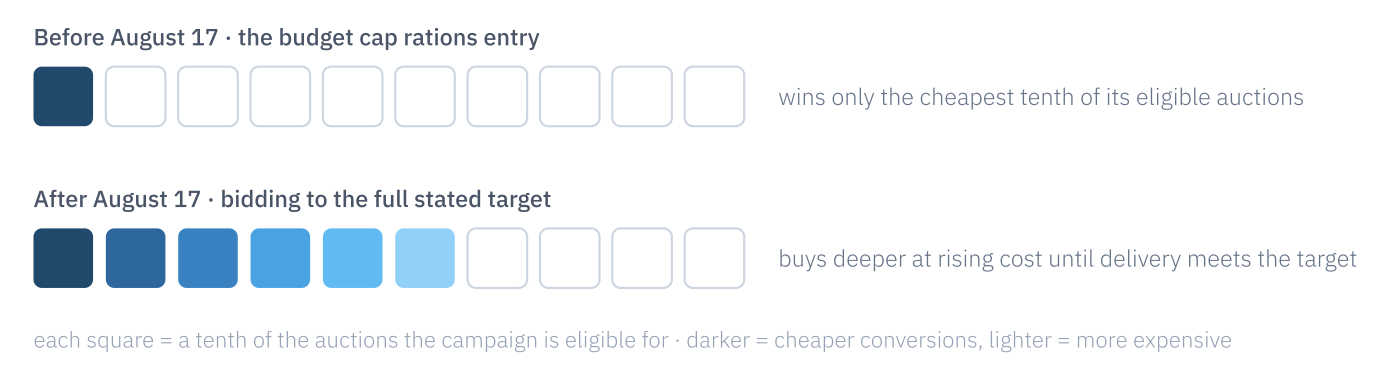
Walk one of those through the change. A budget-capped shopping campaign delivering a claimed ROAS near five, against a stated target of three, drifts toward three: up to two-fifths of its claimed value per pound of spend, gone, with the budget unchanged. And that arithmetic is entirely in the platform's own currency. Ask what those conversions are worth under a stricter lens and the fall starts from a lower base: a campaign can cross from profitable to loss-making without a single alarming number appearing in the interface, because the interface will describe the whole journey as "performing to target."
That account's largest campaign shows the other face of the same problem. It is brand search: claimed ROAS above fifteen, and still flagged as budget-limited. Any realistic target sits far below fifteen, so from August 17 the system has room to chase brand-adjacent auctions it previously skipped, at whatever those cost. Independent measurement consistently shows brand-search conversions to be the least incremental in an account, people who were coming anyway. The drift would spend real new money buying the least real demand, and report it as target discipline.
So the prediction method, for any account: rank every budget-limited target campaign by spend and by impression share lost to budget. That ranking is your exposure list, in order. Then, for each, compare delivered performance against the stated target, in independently measured currency rather than platform-claimed currency, and you know both how far each campaign can fall and what that fall costs in real margin. None of this requires waiting until September's invoice to find out.
The quiet part: this change is regressive
Advertisers who know their unit economics, measured somewhere the platform cannot touch, come out of August 17 fine, maybe ahead. They set a true target, the system honours it more predictably, scaling gets easier. Good.
Advertisers who inherited a target, guessed it, or set it loose two years ago because the campaign kept beating it anyway will simply start paying more per conversion, and the reporting that tells them how it is going will be produced by the counterparty. The change taxes exactly the advertisers least equipped to notice. Nothing about that is illegal or even hidden. It is just what happens when the scorekeeper also sells the tickets.
This is a dress rehearsal
Step back far enough and August 17 is a small preview of where ad buying is going. Every platform is moving toward the same shape: give us a budget and a number, and an AI does the rest. Bids, placements, creative, audience, all inside the black box, all scored by the black box. The August change is mild by comparison. It merely makes one existing control mean what it says.
In that world the only durable asset an advertiser owns is a number the platform did not produce. Your real cost per order. Your real margin per sale. Your real revenue, from your own systems, reconciled to your own bank account. Every negotiation with an algorithm, and that is what a bid target now is, goes better when your side of the ledger was not written by the other party.
What I would actually do before August 17
- Pull every campaign that has shown "Limited by budget" and runs a target strategy. Google's Bid Target Adjustment Tool has been live since July 6 and lists them for you.
- Rank them by impression share lost to budget. The campaigns losing the most are the ones with the furthest to fall, and the first to review.
- Decide your real constraint per campaign, per Meijer's logic. If it is genuinely budget, drop the target and run a maximise strategy. If it is efficiency, set a true target and let the budget breathe. In fairness, Google's position is that matching your target to the campaign's current average performance should preserve similar volume after a brief recalibration; Meijer's counter is that a capped budget plus a target is still two instructions. Nobody has post-August-17 data yet.
- Set that target from numbers measured outside the platform: backend orders, real margin, real revenue. If your target comes from the platform's own reported performance, you have closed the loop entirely, and from August 17 the loop closes tighter.
- Distrust any target you cannot explain. "It's been working" is a description of the past, not a target.
Google is about to do exactly what advertisers have asked of it for years: take the number in the box seriously. As the company's own liaison put it this week, "changing targets should result in performance changes, and that's by design." The uncomfortable question was never whether Google would honour your target. It is whether your target was ever a real number, and whether you would know.